Sites
Smaller than you think.
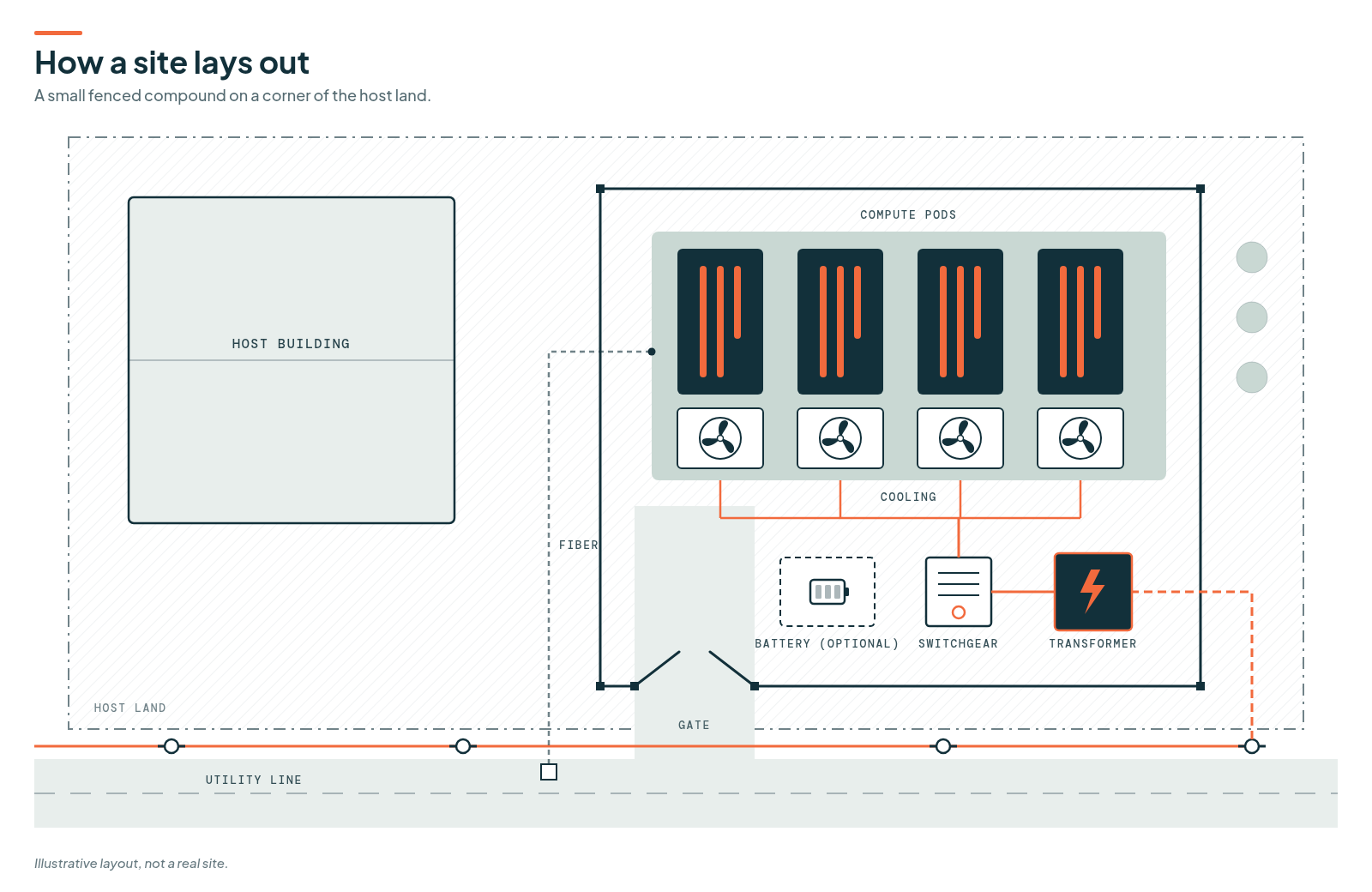
An edge compute site is a fenced pad, a transformer and a few modular units. Most fit on a corner of industrial land. Here are the parts, one by one.


Illustrative layout. Every site is laid out to fit its land, its utility and its county. Download the site plan (PNG)
The parts
The parts, in plain English.
- 01
Utility feeder
The local power line that serves the site. We confirm with the utility how much it can carry.
- 02
Transformer
A pad mount transformer steps the line voltage down for the equipment. Bigger sites use more than one. We measure every site’s MW here, at the transformer.
- 03
Meter and switchgear
The utility meter and the main electrical panel for the site, set on their own pad. This is where power is split out to each compute unit and where it can be shut off safely.
- 04
Pad
A concrete pad sized for the compute units, with room to service them.
- 05
Compute pods
Modular units built in a factory and set by crane. The compute company owns and runs them.
- 06
Cooling
Most designs use closed loop dry coolers that look and sound like big rooftop HVAC units. Water needs are checked in diligence.
- 07
Fiber
An underground line from the nearest carrier route. Two paths where we can get them.
- 08
Fence, gate and access
A secured compound with a lane for trucks and a crane on delivery day.
- 09
Setbacks and sound
Space between the equipment and the property lines, set by local code. We check sound levels against local rules before anyone commits.
- 10
Space for battery storage, optional
Room on the pad for an on-site battery, for backup and resilience, if the design calls for one.
- 11
Host land
The owner keeps the land and the rest of the property. The pad is a small part of it.
Sites can be set up with room for on-site battery storage, for backup and resilience.
Diligence
What we check on every site
- Power at the transformer
- Utility position
- Fiber route
- Zoning and use
- Flood maps
- Easements and setbacks
- Truck and crane access
- Sound at the property line